The carbon footprint of medical cannabis explained: Imported vs UK-grown
The carbon footprint of medical cannabis flower cultivation comes down to how it is grown and how far it has to travel. Conventional indoor cultivation can draw heavily on grid electricity, while much of the flower prescribed in the UK is still imported, often flown thousands of miles.
Here at Glass Pharms®, we grow all of our medical cannabis in the UK, and in the world’s first carbon-negative cannabis cultivation facility, powered by energy generated from food waste rather than the national grid or carbon offsets.
Key takeaways
- The carbon footprint of medical cannabis depends largely on cultivation energy, environmental controls, post-harvest processing and transport.
- Indoor cultivation is not inherently unsustainable, but relying on carbon-intensive grid electricity can create a substantial footprint.
- Imported cannabis may travel thousands of miles before reaching UK patients, adding emissions through freight, handling and storage.
- Glass Pharms grows medical cannabis in the UK using off-grid energy from food waste, natural sunlight and a glasshouse that uses 60% less energy than conventional indoor cultivation.
The UK medical cannabis carbon impact explained
Medical cannabis does not come with a neat environmental score printed on the side of the packet. A product grown under lights in one part of the world and flown into the UK will have a very different footprint to one produced here, using an entirely different energy system.
The UK medical cannabis market has expanded at an almost ridiculous pace over the past two years. More patients are being prescribed medical cannabis every week, and the question is no longer simply whether the sector can keep up with demand. It is whether we can do so in a way that makes sense for the long term, particularly for an industry that is increasingly having to answer for its environmental impact.
Here at Glass Pharms, that question shaped our advanced glasshouse cultivation facility before we ever grew our first crop.
Is indoor cannabis cultivation bad for the environment?
Not by default. That said, most industrial indoor cannabis cultivation setups do consume a lot of energy.
Medical cannabis has to be grown under close supervision. The growing environment simply cannot be left to chance. Humidity, airflow, lighting, and cleanliness all need to be managed properly if the end product is going to be consistent, reliable, and suitable for patients, and pass the strict regulatory standards here in the UK.
That means power. Quite a lot of it, in many cases. So it is easy to see why many would treat outdoor growing as the obvious environmental answer.
It may sound simple, but medical cannabis is not a crop where you can just plant, wait, and hope the British weather behaves itself. And that’s before even considering the extra hoops required with medical cannabis cultivation. Producing pharma-grade cultivars requires far greater control over the growing environment, how the plants are handled during the cultivation process, and post-harvest.
The issue is not the plant, but with the energy model behind the facility growing it, and how environmentally conscious the team and facility really are.
What is the carbon footprint of cannabis?
To get the most out of the genetics a cultivation team has spent years selecting and refining, a medical cannabis facility has to give every plant the right conditions, consistently, from propagation through to harvest, and then through the vital post-harvest period.
That means much more than keeping a few grow lights on.
- Lighting: Cannabis plants need a reliable light schedule and enough intensity to grow properly. Even in a perfectly set up and situated glasshouse, especially here in the UK, sunlight is often not enough.
- Temperature and humidity: Heating, cooling, ventilation, and dehumidification must be controlled to keep the growing environment stable and help protect flower quality.
- Airflow and carbon dioxide: Moving air helps prevent mould and disease, and keeps the growing canopy full of fresh air to support photosynthesis and plant development.
- Water and nutrients: Plants need a precise, consistent supply of both water and a shifting range of nutrients throughout the growing cycle.
- Drying and storage: Once harvested, the flower still needs carefully controlled conditions to remain of the highest quality and to pass regulatory standards
A 2021 Nature Sustainability study into the greenhouse gas emissions of indoor cannabis production found that a facility’s emissions can vary dramatically depending on its location, local climate and, above all, the carbon intensity of the electricity grid it relies on.
How Glass Pharms is taking a greener approach to medical cannabis cultivation in the UK
Glass Pharms was built on a fairly straightforward idea: if you are going to grow medical cannabis indoors, the energy question cannot be an afterthought.
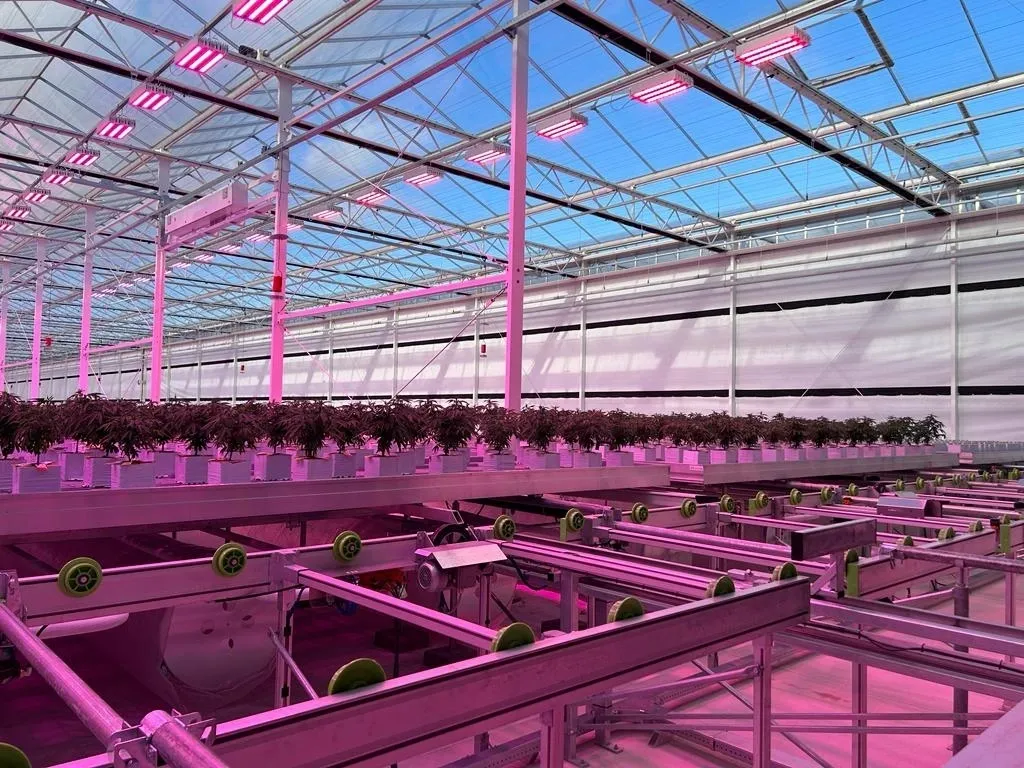
Our UK glasshouse runs entirely off-grid. The heat and power come from an on-site anaerobic digester, which processes food waste that would otherwise be sent to landfill. We do not draw any electricity from the national grid, and we do not buy offsets.
That matters because methane is one of the main gases produced as organic waste breaks down in landfill, and it is substantially more potent than carbon dioxide as a greenhouse gas.
We produce 100% of our energy needs in-house. Around 40% of the light our plants need comes directly from the sun. The rest is supplemented, when needed, through our off-grid energy system. Our next-generation glasshouse design uses 60% less energy than a conventional indoor cannabis cultivation facility.
That is why we can proudly say that Glass Pharms is carbon negative by design. It comes from how the facility produces and uses waste energy, rather than from a stack of offsets purchased somewhere else.
We also catch rainwater from the glasshouse roof, which is treated, stored and recycled through a closed-loop system to meet all of the facility’s water needs.
FAQs about imported and UK-grown medical cannabis
Why does the UK import so much medical cannabis?
There is simply not enough grown here in the UK to keep up with the supply demand, and the medical cultivation industry is relatively young compared to many overseas markets.
Up until February 2025, all medical cannabis flower prescribed to UK patients was sourced from overseas, mostly from facilities in Canada, the USA, and Portugal, although much came from even further afield. Many of these countries have far lower regulatory standards and oversight than here in the UK. Producing pharma-grade flower at scale requires specialist facilities, strict quality systems and the ability to deliver consistent crops.
In early 2025, Glass Pharms® partnered with Releaf to supply domestically grown medical cannabis flower to UK patients for the first time in the country’s history, and we now supply to many of the major medical cannabis clinics operating in the UK.
Does importing medical cannabis increase its carbon footprint?
It can. Imported flower may travel thousands of miles through international freight networks before it reaches a UK pharmacy, and then patients’ doorsteps. That journey adds transport, handling, and storage to the product’s overall footprint. Cultivation energy remains a major consideration, but cutting unnecessary supply-chain distance is an obvious part of building a more sustainable medical cannabis sector.
Is UK-grown medical cannabis always lower carbon?
Not always. Growing cannabis here in the UK obviously reduces the need for long-distance freight, but we are the only domestic facility that does not need substantial on-grid energy and water supply. The environmental benefits heavily depend on how a facility is designed, powered, and operated. The strongest approach combines local production with a lower-impact energy system, rather than treating “UK-grown” as a sustainability claim in itself.
Head over to “How Glass Pharms grows medical cannabis off-grid, powered by food waste” to learn more about our full cultivation process.
From imported flower to a more environmentally conscious domestic medical cannabis supply
The UK public is increasingly becoming more socially aware, and that includes a heavy emphasis on the environmental impact of the choices they make. UK medical cannabis patients are often even more conscious of these types of choices, particularly as their treatment becomes a major part of their everyday life choices.
They have every right to ask questions regarding how their medicine was grown, how far it travelled, and how its cultivation footprint was handled.
Imported flower will long have a place in the UK medical cannabis system, but right now, the UK has a huge opportunity to build a cleaner, more resilient domestic supply alongside it. That is exactly the space we are already operating in, offering UK patients pharma-grade medical cannabis grown right here in the UK without relying on the national grid, carbon offsets, or international air freight.
Disclaimer: This article is for general information only. It discusses the environmental impact of medical cannabis cultivation and supply chains, not the suitability, safety or effectiveness of medical cannabis as a treatment. Medical cannabis is not suitable for all patients and can only be prescribed by a clinician listed on the GMC Specialist Register.
Share this post: