Irradiated vs non-irradiated medical cannabis: understanding the difference
Irradiated medical cannabis flower has been treated with ionising radiation to reduce microorganisms such as bacteria, yeasts, and moulds. Non-irradiated flower has not undergone that treatment. Both require controls and testing to demonstrate that they meet the applicable quality requirements.
Here at Glass Pharms®, we never irradiate our medical cannabis flower, but instead manage microbial control throughout cultivation and post-harvest handling. Understanding the distinction means looking at why irradiation is used on some medical cannabis flower sold here in the UK, what research shows about its effects, and what the label can tell you about the flower.
Key takeaways
- Irradiation reduces viable microorganisms in medical cannabis flower, but does not physically remove mould or guarantee sterility.
- Non-irradiated flower must still meet applicable microbial quality requirements through production controls and testing.
- Studies generally report stable THC and CBD levels under the conditions tested, while terpene changes vary.
- Different microbial standards can mean imported flower needs additional treatment before UK supply.
- Glass Pharms® never irradiates its medical cannabis flower, using preventative hygiene, controlled cultivation, careful post-harvest handling and testing.
Irradiated vs non-irradiated medical cannabis at a glance
| Irradiated flower | Non-irradiated flower | |
| Treatment | The flower has undergone treatment with ionising radiation to reduce viable microorganisms. | The flower has not undergone irradiation. Microbial quality must be managed without this treatment. |
| THC and CBD | A 2016 study of gamma irradiation in medical cannabis found no change in total THC or CBD across four varieties treated at 10 kGy. | THC and CBD content depends on the variety, production conditions and storage. Non-irradiated status alone does not indicate higher cannabinoid levels. |
| Terpenes | The 2016 study found reductions of 10% to 20% in affected individual terpenes, with reductions reaching 38% for individual compounds. That said, 2023 research on irradiation and cannabis composition reported little effect on terpenes under its tested conditions. | The flower avoids irradiation-related terpene losses. However, non-irradiated status does not guarantee a higher terpene content than another product. |
| Microbial reduction | The 2023 study reported bacterial and yeast-and-mould counts below 10 colony-forming units per gram after gamma irradiation at doses of 15 to 20.8 kGy. | There is no single microbial count associated with non-irradiated flower. Testing establishes whether a batch meets the applicable requirements. |
| Testing and quality controls | Irradiation does not replace testing and wider quality controls. | The absence of irradiation does not remove the need for testing and wider quality controls. |
NOTE: The terpene percentages refer to reductions in individual compounds, not total terpene content. These findings relate to specific gamma-irradiation treatments. We break down the studies and their limitations further below.
What is cannabis irradiation, and why is it used?
Cannabis irradiation uses ionising radiation to reduce viable microorganisms in flower, helping it meet microbial quality requirements. Like any agricultural crop, cannabis requires protection from bacteria, yeasts, and moulds throughout cultivation and processing.
How effectively these are controlled helps determine whether an additional decontamination step is needed. More on this later.
The purpose of cannabis irradiation is straightforward: to reduce the number of microorganisms capable of surviving and multiplying in the flower itself. A 2020 study comparing methods of reducing fungal contamination in medical cannabis found substantial microbial reductions following both gamma and electron-beam treatment.
There is, however, a distinction between inactivating mould and actually removing it.
Irradiation does not physically remove fungal material from the flower, and a lower viable count does not guarantee complete sterility. Preventative action, careful handling, and thorough testing remain essential.
Why can imported medical cannabis need additional treatment?
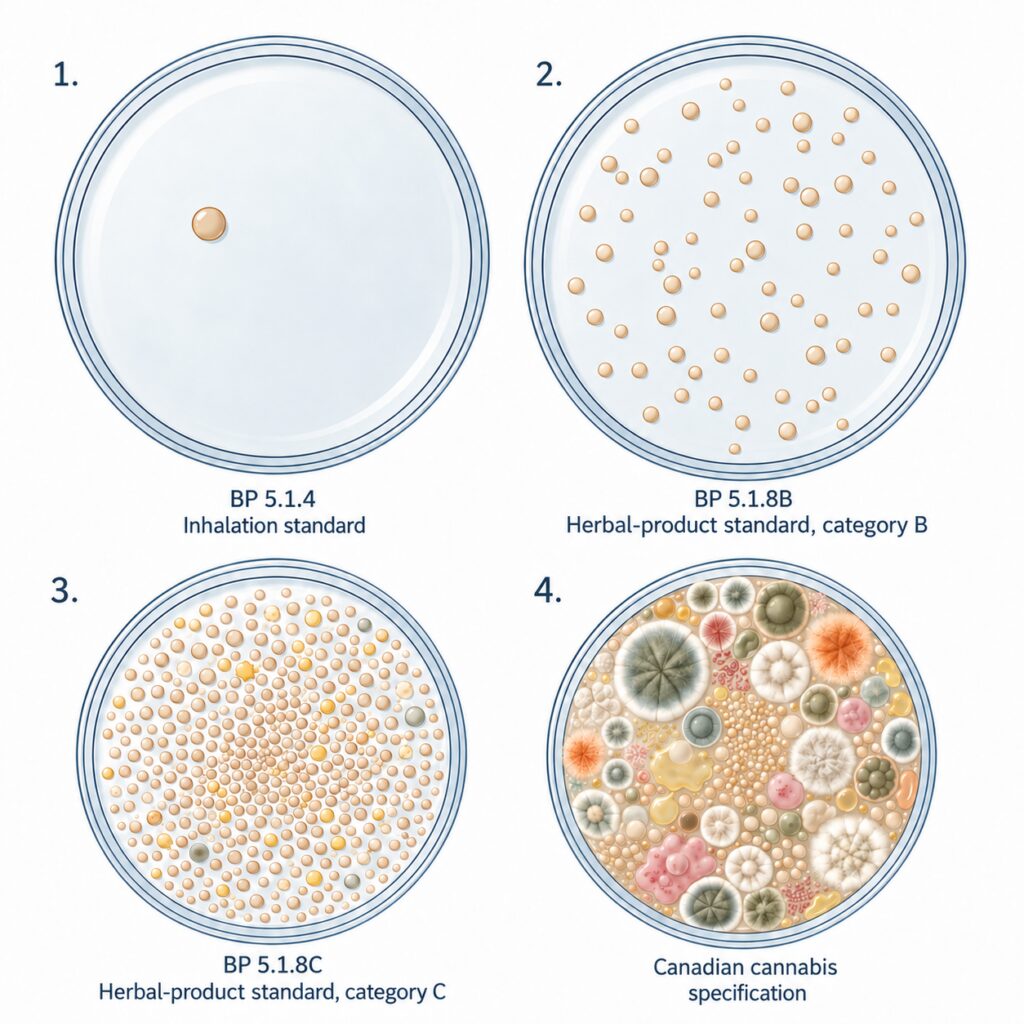
Flower can meet the requirements in its country of origin but still need further treatment before it can be legally prescribed to UK patients. For example, Health Canada accepts herbal-product microbial standards for smoked or vaped dried cannabis, while the MHRA expects alignment with inhalation requirements, with deviations requiring justification.
The Petri dishes below illustrate the specifications being compared. BP means British Pharmacopoeia, a collection of medicine quality standards. Dish one represents its inhalation specification, while dishes two and three represent herbal-medicine categories B and CANNABIS. Dish four shows the Canadian comparison, where accepted herbal standards can overlap with category C.
These differences help explain why some flower must undergo irradiation to reduce microbial counts before entering the UK market. Whether treatment is needed depends on the batch’s results and the specification it must meet.
What is the difference between gamma and beta irradiation?
Gamma irradiation uses high-energy electromagnetic radiation, while beta treatment, also called electron-beam or e-beam, uses accelerated electrons. Both damage microorganisms and disrupt their ability to reproduce.
Gamma systems typically rely on a radioactive source, while e-beam equipment generates its beam electrically. That distinction can (and does) cause some confusion. Although e-beam uses no radioactive source, it still exposes the flower to ionising radiation and cannot be described as a non-irradiating treatment.
Does irradiation make medical cannabis radioactive?
No. Irradiation does not make medical cannabis radioactive. The flower is exposed to ionising radiation during treatment, but radioactive material is not added to it or left behind.
Irradiation and radioactive contamination are different things. The process can change the material it treats, including damaging microorganisms, without turning the flower itself into a source of radiation.
What does non-irradiated medical cannabis mean?
Non-irradiated medical cannabis flower has not undergone irradiation. It is still harvested, dried, and cured, so the term should not be confused with “unprocessed”. Neither does it remove the need to meet applicable microbial quality requirements.
The label tells you which treatment was not used. Understanding how the flower was produced requires a closer look at the grower’s approach.
Does Glass Pharms irradiate its medical cannabis flower?
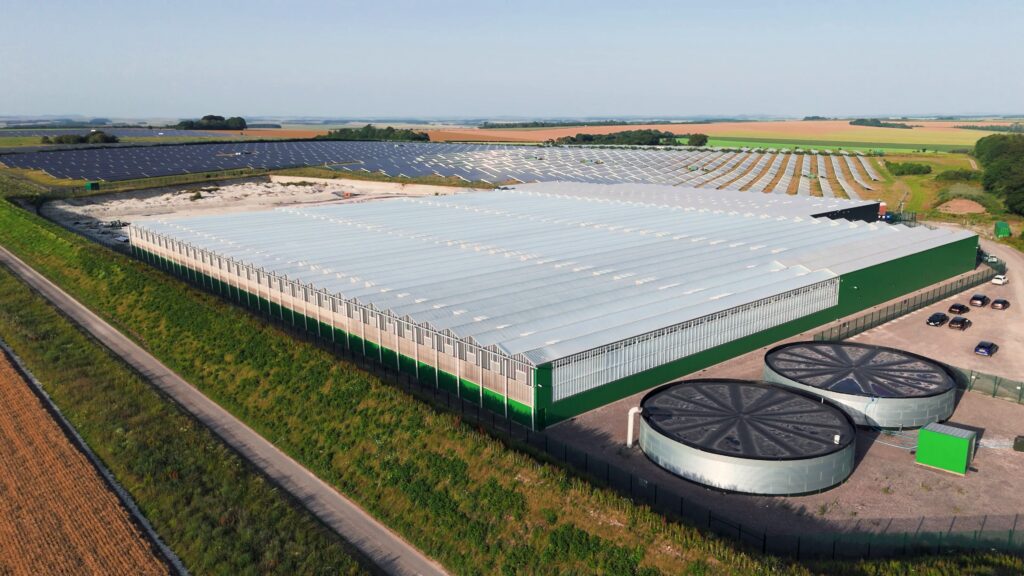
Glass Pharms never irradiates its medical cannabis flower. Our approach combines controlled growing conditions with strict hygiene and careful post-harvest handling.
At our UK medical cannabis facility, staff enter through airlocks and wear dedicated on-site clothing, while robotic logistics reduce manual contact with plants. Protection continues through drying, curing and storage, with traceability following the material from propagation through to collection.
As our CEO, James Duckenfield, explains:
“We are fanatical about hygiene, but producing non-irradiated flower takes more than keeping a facility clean. Microbial control was fundamental to the design of Glass Pharms. Our airflow moves vertically through the crop, carrying moisture away from the plants, and we bring plants to the people working on them, reducing unnecessary contact and the movement of contamination around the glasshouse.
“You can spend months managing those conditions and then compromise that work after harvest. The flower still contains microorganisms and the nutrients they need, so controlling the water available to them is essential. That is why we monitor water activity throughout drying and curing, rather than simply deciding that flower feels dry enough to pack. The process takes approximately two to three weeks, sometimes longer, because we want a stable product while preserving its structure and volatile compounds.
“Irradiation can reduce microbial numbers, but it does not physically remove mould that has already grown, or protect flower from poor handling and storage afterwards. Our approach is to prevent microbial proliferation throughout the process, then check that those controls are working through testing in our own laboratory and with external specialists.
“That is what sits behind our commitment never to irradiate our flower. We have designed the whole process around meeting the required microbial standards without it. We are producing material that will become medicine, and that discipline has to run all the way through.”
Does irradiation affect THC, CBD, or terpenes?
The most recent, publicly available research into cannabis irradiation has found THC and CBD levels remained largely unchanged under the conditions tested, while effects on terpenes varied. That said, researchers measure these groups of compounds separately, so a stable cannabinoid result does not necessarily mean the flower’s entire chemical composition is unchanged.
What the currently available research shows
- A 2016 study examining gamma irradiation in medical cannabis compared four cannabis varieties before and after treatment. Total THC and CBD remained unchanged. Some individual terpenes decreased, generally by 10% to 20%, with cis-ocimene and terpinolene each falling by 38% in one of the flower varieties tested.
- A 2023 study assessing the effects of gamma irradiation on cannabis composition found no changes in cannabinoids and little effect on terpenes under its tested conditions.
- A 2025 study comparing electron beam treatment and storage in hemp flowers examined two hemp cultivars and reported an immediate 8.4% reduction in total terpene content after treatment. Cannabinoid levels remained stable throughout.
Read together, these three studies suggest that cannabinoids are relatively stable under the irradiation conditions tested, while terpene changes vary. Avoiding irradiation removes one potential source of terpene loss, although it does not guarantee a richer aroma or greater clinical benefit.
Importantly, none of these studies establish whether the measured differences affect treatment outcomes for actual medical cannabis patients.
Is non-irradiated medical cannabis better than irradiated medical cannabis?
There are good reasons for UK patients to prefer flower produced domestically that meets microbial quality requirements without irradiation. Avoiding a treatment that can alter some terpenes is one of them. Whether that flower provides better symptom relief is a separate question, which the studies discussed here do not answer.
There is also a major distinction worth remembering.
Irradiation reduces viable mould by preventing fungal cells and spores from growing or reproducing. It does not physically remove that material. Preventing contamination before it can take hold remains essential.
In June 2021, two batches of imported medical cannabis flower were recalled following reports of possible mould contamination. The notice did not specify their irradiation status, but it illustrates why patients need confidence in the whole production process.
Glass Pharms® never irradiates medical cannabis flower. Preventative action during cultivation and post-harvest handling, along with regular testing to verify that those controls are working, makes this possible.
To learn more about how we do things here at Glass Pharms, check out the Glass Pharms® post-harvest process explained and What is THCV? From cannabinoid research to cultivation at Glass Pharms®.